Percipio logo

AI Access Does Not Mean Adoption

Most companies have already bought the tools. Getting people to use them is a different problem, and it has a proven solution.

Curtis
Curtis
AI Access Does Not Mean Adoption

A few weeks into a recent engagement, someone watched me pull insights out of weeks of meeting recordings. They asked how I did it. So I showed them the steps and shared a few tips on how they might get started themselves.

They nodded. They got it. Then they went back to their desk and worked the way they always had.

I checked in later to see what stuck. The honest answer? Not much. Even after seeing the outcome, the method, and the starting tips, what they could do on their own was limited.

Last week I built a ready-to-use AI workspace for a team, loaded it with their material, set it up with a tailored persona to answer their questions, and walked them through it. They still asked me to run it for them.

That’s not a knock on them. They’re sharp people who are stretched thin. It’s a knock on how most organizations think about AI adoption. We treat it like a technology tool you just hand someone. It isn’t. It’s a change in how the work gets done, and that’s a different problem.

People aren’t lazy. They’re busy.

Here’s the pattern I see most with individual change. People already know they could be doing the work better and faster. They’re not resistant to the idea. They just can’t afford to stop, in the middle of a full workload, to learn a different way of doing something they already know how to do the old way.

That’s the quiet tax on every technology transformation. The old way works well enough to survive the day. The new way costs time and friction up front, before it pays anything back. So people stay with what they know, not out of stubbornness, but out of arithmetic.

I’ve spent decades watching this pattern and helping teams break the cycle. Change is hard for reasons unrelated to willingness. So the job isn’t convincing people. It’s up to leaders to help them, with enough structure that the cost of switching doesn’t land entirely on someone who’s already underwater.

The trap: AI looks too easy.

AI makes this harder, not easier, and for a surprising reason. It looks simple. You type, it answers. It’s just a chat.

That surface ease fools everyone. People try the techology once, get a decent answer, and assume they’ve got it, which quietly caps how good they ever get. Leaders watch their teams typing into a box and assume no real support is needed, because what is there to train on a chat?

But getting genuine value out of these tools has prerequisites. Knowing how to frame a problem, give the model the right context, build something reusable instead of starting over every time, and judge when the output is good enough to trust. None of that is obvious from the chat box. It’s exactly the kind of thing a little structure makes teachable.

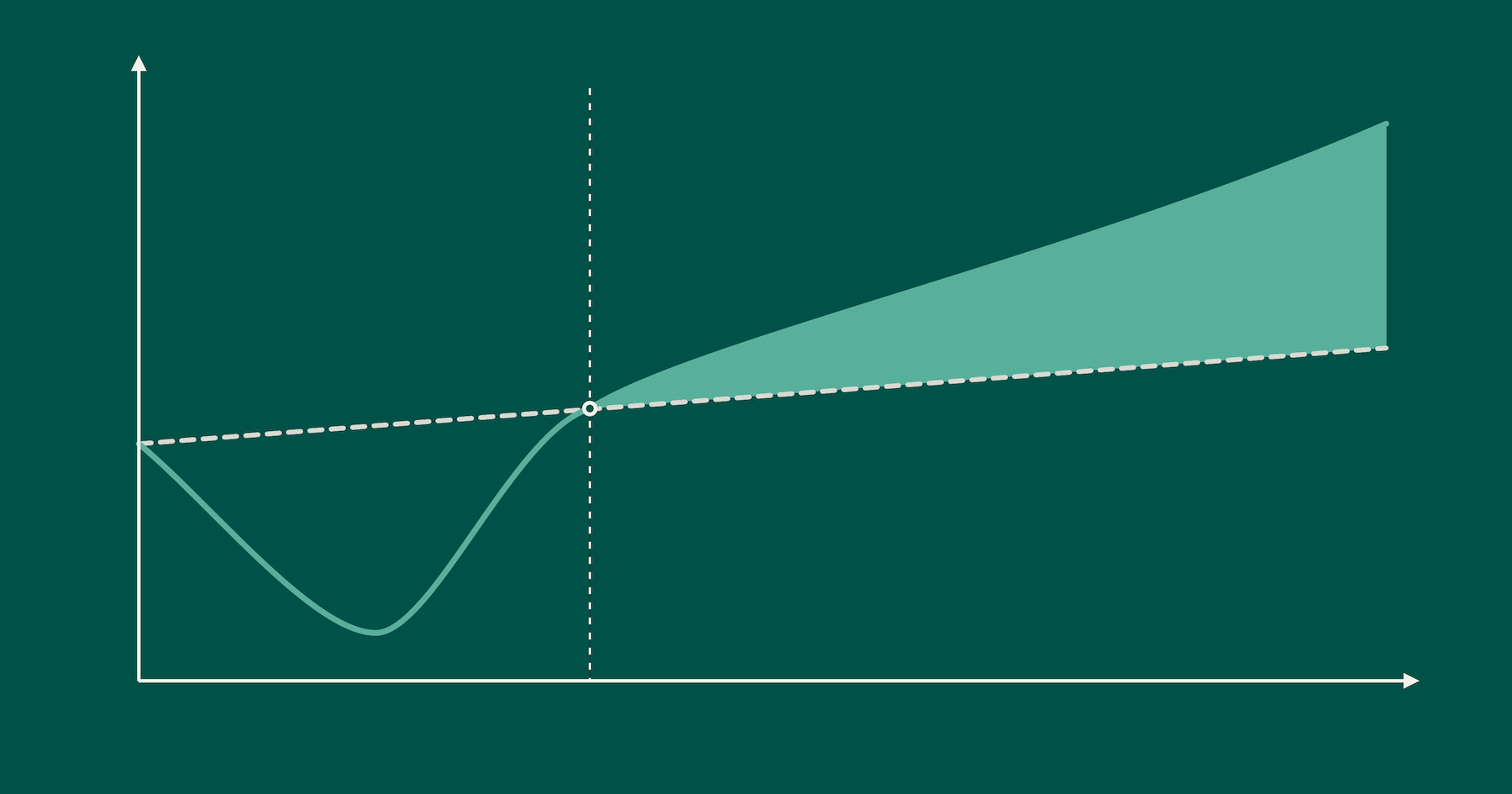
I watched this play out while running an AI fluency program. People’s self-rated proficiency actually dropped right after the training. Not because they learned less, but because they finally saw how much the tool could do and realized it asked for a different way of working than they’d assumed. That drop is a good sign. It’s the moment “this is easy” turns into “I can actually get better at this.”
You don’t have one starting point for adoption.

Most companies I work with have already paid for the tools. The licenses are active. The capability is sitting on every desktop. And usage is all over the map.

In any organization, you have the full range. A few people taught themselves, went deep, and are already pulling real value out of these tools. A big group sits in the middle. And plenty haven’t had the time to try at all.  Leaving adoption up to chance is where ROI risk creeps in.

The mistake is treating everyone the same. Blast one training at all of them, and you bore the advanced users, lose those just starting, and move almost no one. A structured approach to change and AI adoption does the opposite. It lets the advanced users serve as inspiration for others without waiting for permission, while getting everyone else their own muscle.

Providing structure is the work of leadership.

This is what a structured change approach actually does, and it’s what we recommend to clients trying to get a return on the AI they’ve already bought.

It isn’t a training calendar. It’s leaders building the conditions that turn a one-time “show me how” into a durable new way of working: clarity on who needs to do what differently, the prerequisites taught in the right order, reinforcement after the novelty fades, permission to spend time learning, and support tuned to where each person actually is on their AI journey.

Skip that, and you’ve bought capability you’ll never capture. The tools get used by the two or three people who would have figured them out anyway, and everyone else keeps moving files from one system to the next.

The prize is bigger than cost.

Here’s what it looks like when it works.

In a training course I was running, we were halfway through the course, and one participant came back having built an entire dashboard. It pulled together data sources they used to search through by hand. What had taken days of finding and wrangling data became the push of a button. It visualized everything so they could spot the strongest sales opportunities, compare leads, and automate outreach to chase new customers faster.

I asked what it would have taken to build that before AI. Four to six weeks of their IT team’s time, they said. Then they corrected themselves: in reality, it never would have been built at all, because IT is stretched far too thin to take it on.

With a little structured change support and leadership prioritizing this, in three weeks, one person built something that simply wasn’t possible before. That’s the part leaders miss when the AI conversations start and end with cost and efficiency.

Cost savings are real, and I won’t pretend otherwise. But that’s the smaller half of the story. The bigger half is what your people do with the capacity you give back: understanding a customer more deeply, inventing a better solution, reaching customers you couldn’t serve before. Not a leaner cost line. A workforce pointed at your customers’ hardest problems, and at the new ones you haven’t reached yet.

You don’t get there by buying the tool. You get there by changing how your people work, on purpose, with a plan.

Answering the hard questions

The question for a leader right now isn’t “what AI should we buy?” You’ve probably already bought it. It’s sitting idle on most of your desktops.

The harder questions are the ones worth your time. Have you built the structure for your people to actually use it, wherever they are on the path? And are you aiming all that freed-up potential at something that matters? Welcome to the era of AI Powered Change Management.

Percipio Icon
Challenges
Services
No items found.
Solutions

A few weeks into a recent engagement, someone watched me pull insights out of weeks of meeting recordings. They asked how I did it. So I showed them the steps and shared a few tips on how they might get started themselves.

They nodded. They got it. Then they went back to their desk and worked the way they always had.

I checked in later to see what stuck. The honest answer? Not much. Even after seeing the outcome, the method, and the starting tips, what they could do on their own was limited.

Last week I built a ready-to-use AI workspace for a team, loaded it with their material, set it up with a tailored persona to answer their questions, and walked them through it. They still asked me to run it for them.

That’s not a knock on them. They’re sharp people who are stretched thin. It’s a knock on how most organizations think about AI adoption. We treat it like a technology tool you just hand someone. It isn’t. It’s a change in how the work gets done, and that’s a different problem.

People aren’t lazy. They’re busy.

Here’s the pattern I see most with individual change. People already know they could be doing the work better and faster. They’re not resistant to the idea. They just can’t afford to stop, in the middle of a full workload, to learn a different way of doing something they already know how to do the old way.

That’s the quiet tax on every technology transformation. The old way works well enough to survive the day. The new way costs time and friction up front, before it pays anything back. So people stay with what they know, not out of stubbornness, but out of arithmetic.

I’ve spent decades watching this pattern and helping teams break the cycle. Change is hard for reasons unrelated to willingness. So the job isn’t convincing people. It’s up to leaders to help them, with enough structure that the cost of switching doesn’t land entirely on someone who’s already underwater.

The trap: AI looks too easy.

AI makes this harder, not easier, and for a surprising reason. It looks simple. You type, it answers. It’s just a chat.

That surface ease fools everyone. People try the techology once, get a decent answer, and assume they’ve got it, which quietly caps how good they ever get. Leaders watch their teams typing into a box and assume no real support is needed, because what is there to train on a chat?

But getting genuine value out of these tools has prerequisites. Knowing how to frame a problem, give the model the right context, build something reusable instead of starting over every time, and judge when the output is good enough to trust. None of that is obvious from the chat box. It’s exactly the kind of thing a little structure makes teachable.

I watched this play out while running an AI fluency program. People’s self-rated proficiency actually dropped right after the training. Not because they learned less, but because they finally saw how much the tool could do and realized it asked for a different way of working than they’d assumed. That drop is a good sign. It’s the moment “this is easy” turns into “I can actually get better at this.”

You don’t have one starting point for adoption.

Most companies I work with have already paid for the tools. The licenses are active. The capability is sitting on every desktop. And usage is all over the map.

In any organization, you have the full range. A few people taught themselves, went deep, and are already pulling real value out of these tools. A big group sits in the middle. And plenty haven’t had the time to try at all.  Leaving adoption up to chance is where ROI risk creeps in.

The mistake is treating everyone the same. Blast one training at all of them, and you bore the advanced users, lose those just starting, and move almost no one. A structured approach to change and AI adoption does the opposite. It lets the advanced users serve as inspiration for others without waiting for permission, while getting everyone else their own muscle.

Providing structure is the work of leadership.

This is what a structured change approach actually does, and it’s what we recommend to clients trying to get a return on the AI they’ve already bought.

It isn’t a training calendar. It’s leaders building the conditions that turn a one-time “show me how” into a durable new way of working: clarity on who needs to do what differently, the prerequisites taught in the right order, reinforcement after the novelty fades, permission to spend time learning, and support tuned to where each person actually is on their AI journey.

Skip that, and you’ve bought capability you’ll never capture. The tools get used by the two or three people who would have figured them out anyway, and everyone else keeps moving files from one system to the next.

The prize is bigger than cost.

Here’s what it looks like when it works.

In a training course I was running, we were halfway through the course, and one participant came back having built an entire dashboard. It pulled together data sources they used to search through by hand. What had taken days of finding and wrangling data became the push of a button. It visualized everything so they could spot the strongest sales opportunities, compare leads, and automate outreach to chase new customers faster.

I asked what it would have taken to build that before AI. Four to six weeks of their IT team’s time, they said. Then they corrected themselves: in reality, it never would have been built at all, because IT is stretched far too thin to take it on.

With a little structured change support and leadership prioritizing this, in three weeks, one person built something that simply wasn’t possible before. That’s the part leaders miss when the AI conversations start and end with cost and efficiency.

Cost savings are real, and I won’t pretend otherwise. But that’s the smaller half of the story. The bigger half is what your people do with the capacity you give back: understanding a customer more deeply, inventing a better solution, reaching customers you couldn’t serve before. Not a leaner cost line. A workforce pointed at your customers’ hardest problems, and at the new ones you haven’t reached yet.

You don’t get there by buying the tool. You get there by changing how your people work, on purpose, with a plan.

Answering the hard questions

The question for a leader right now isn’t “what AI should we buy?” You’ve probably already bought it. It’s sitting idle on most of your desktops.

The harder questions are the ones worth your time. Have you built the structure for your people to actually use it, wherever they are on the path? And are you aiming all that freed-up potential at something that matters? Welcome to the era of AI Powered Change Management.

Ready to work with us?