


Most organizations don’t lack approaches for capability-building. They lack a strategy for which capabilities matter and why. The result is a pattern that repeats with remarkable consistency: a training calendar full of well-attended sessions, a tool rollout, a reorg. And six months later, the business is still blocked on the same things, and the return on all of it is in question.
That gap between activity and outcome is not a training quality problem. It is a sequencing problem. Capability building provides its best return when it’s treated as a strategic discipline before anything gets built. And with AI now touching nearly every stage of that discipline, the firms that get the strategy right at the beginning are the ones who will get real leverage out of AI. Everyone else will just have faster versions of the same scattershot approach.
The good news is that the sequencing isn’t complicated. It does require being precise about what a capability actually is.
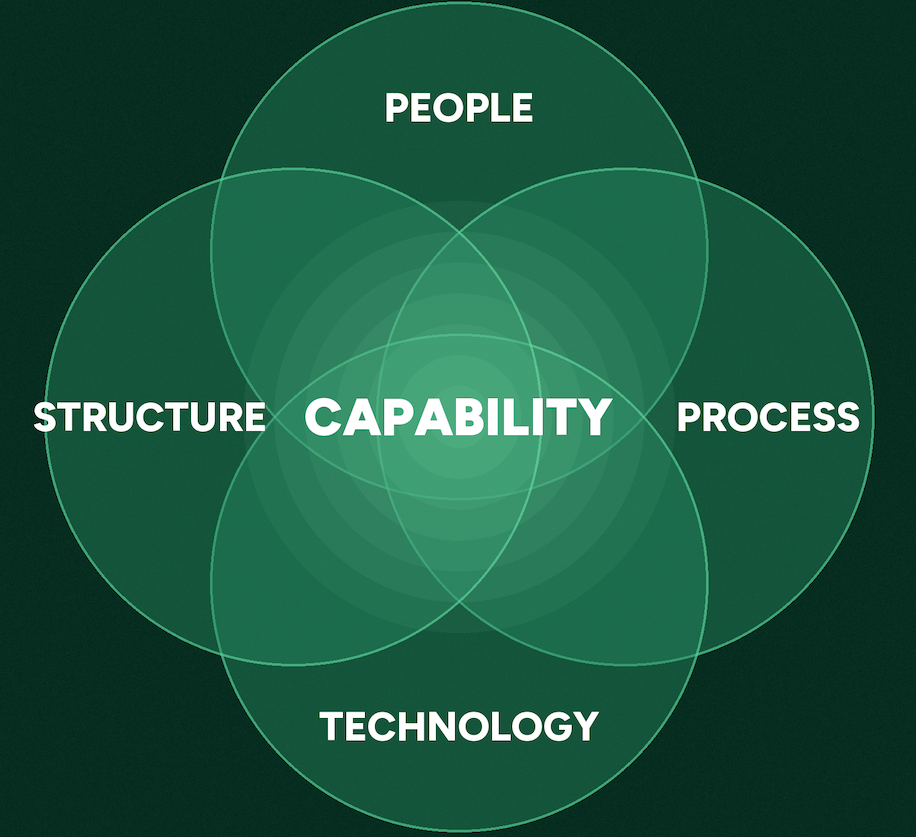
What “Capability” Actually Means
A capability is not a skill, a headcount number, or a piece of software. It is the combination of people, process, technology, and structure that reliably produces a specific outcome. A team can complete a training course and still not have the capability, because the process it plugs into hasn’t changed, the incentives don’t reward the new behavior, or only one person on the team truly knows how to execute on it.
This is where a surprising number of capability initiatives go wrong before they even start. Teams build a training program when the real gap was a decision-rights problem. They buy a platform when what they needed was a clearer process. Getting the definition right doesn’t just save wasted effort later. It determines whether the initiative addresses the actual problem.
With that precision established, the next question is where to begin.
Start from Strategy, Not from Gaps
Most organizations begin by inventorying what people can do today and trying to fill the gaps they find. It feels rigorous. It often isn’t.
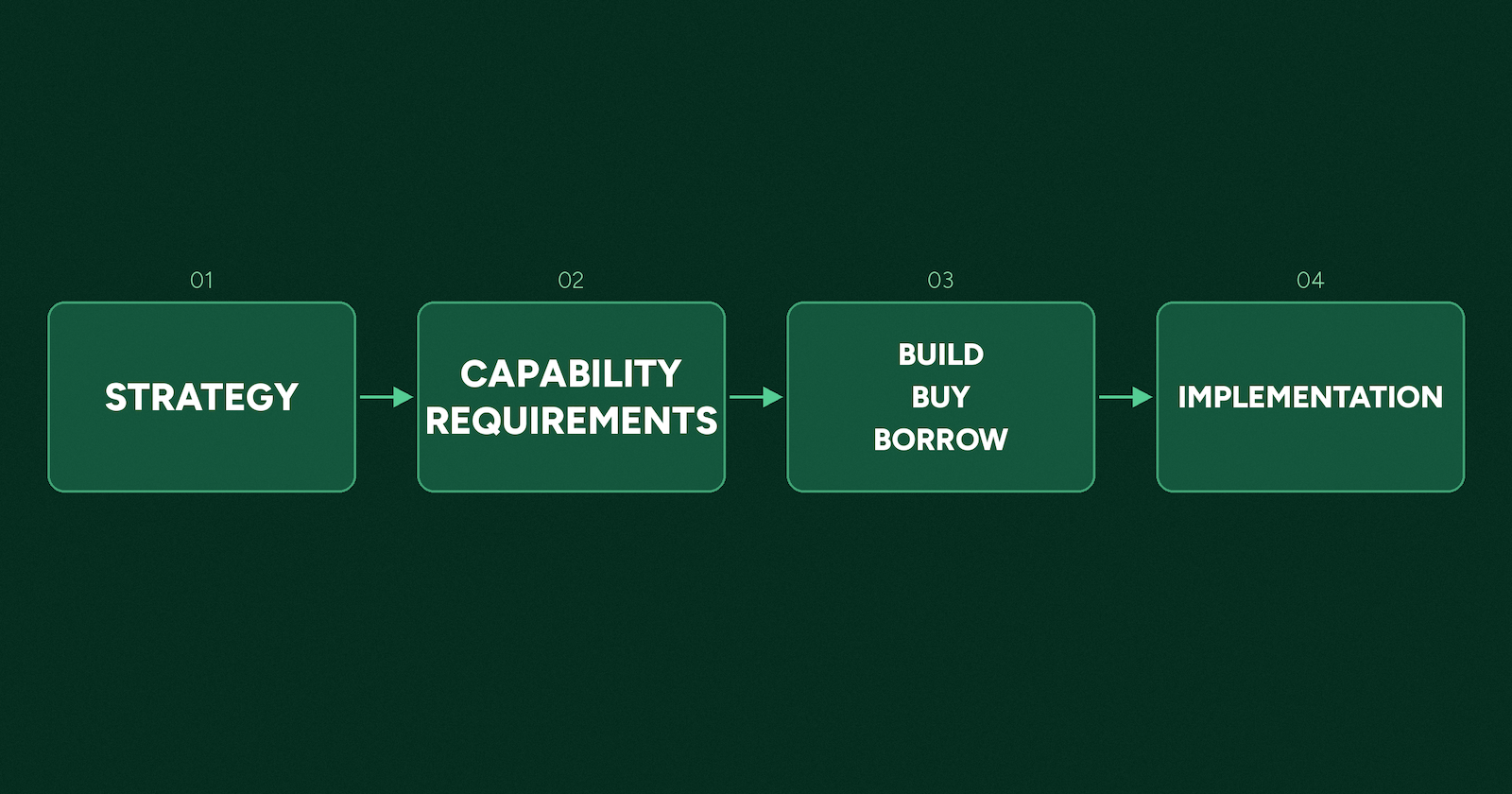
A stronger approach inverts the sequence: start from where the business is headed or the problem its looking to solve, whether it’s a new market, new operating model, or new regulatory exposure, and work backward to the capabilities that strategy actually requires. Capability plans built on a skills gap analysis alone tend to produce initiatives that are technically sound and strategically irrelevant. This result is largely because they anchor on today’s baseline rather than tomorrow’s requirement.
Once the target capabilities are clear, organizations face a decision that typically has more impact on speed and cost than anything that happens inside a training room.
Build, Buy, or Borrow
For each capability gap, there are three real levers: develop it internally, acquire it through hiring, acquisition, or licensing, or access it through partners and managed services. Most organizations default straight to “hire and train” without stopping to ask whether a capability that isn’t core to a competitive advantage might be better rented than built. That single decision, made well, can change the economics and timeline of the entire initiative.
But even the right choice here can fail if the next checkpoint isn’t kept clearly in view.
Individual Skill Is Not Organizational Capability
Sending twenty people to a course builds their individual skills. It does not guarantee the organization can reliably do the thing, because that also depends on the process the skill feeds into, the tools that support it, the incentives that make people actually use it, and enough depth that the capability survives someone leaving. This is where many well-funded capability development programs quietly stall: the people acquired new skills, but nothing in the system around them changed. The capability didn’t move.
Strategic checkpoints are worth revisiting throughout any initiative, because the metrics that tend to be measured, including enrollment, completion and satisfaction scores, often track individual skills over organizational capabilities.
Ownership, Sequencing, and Proof
Three more elements round out a sound capability plan, and each one addresses a failure mode that surfaces predictably in practice.
Someone must own the capability once it exists, or it erodes within a year or two as the people who built it move on. Some capabilities are prerequisites for others: building analytics capability before the underlying data infrastructure is in place means the investment sits unused. And the plan needs a real definition of success from the beginning; successes that are tied to the business outcomes the capability was meant to produce, not to attendance rates or rollout completion.
These aren’t afterthoughts. They are what separates a capability that sticks from one that looks good in a retrospective slide deck and then quietly disappears withought providing a return on investment.
That is the strategic foundation. With it in place, the conversation about AI becomes significantly more productive, because AI doesn’t replace the strategic work. It changes what’s possible once that work is done.
Where AI Earns Its Place
AI changes the economics of several stages of capability building, if it’s pointed at the right layer of the problem.
- Diagnosis gets sharper. AI can synthesize scattered signals, drawing from staffing history, performance data, project outcomes, and market movement to produce a clearer picture of where capabilities actually stand versus where strategy says they ought to be. It does this faster and with less self-report bias than the typical manager survey.
- Individual skill-building accelerates. Adaptive content, simulated practice, and in-the-moment coaching can compress the time it takes someone to build genuine judgment on high-stakes tasks, not just familiarity with the material.
- Tacit knowledge becomes explicit. A meaningful share of organizational capability lives in a small number of people’s heads. AI is well suited to extracting that knowledge and turning it into a structured playbook. That is a direct answer to the “capability survives someone leaving” problem.
- Capabilities get embedded in the work itself, not just taught alongside it. This is the highest-leverage use, and the one most organizations under-exploit. Instead of training people and hoping they apply it later, the guidance is built into the tool they already use, so the right decision or process step surfaces in the moment. That turns capability into standing infrastructure rather than a one-time knowledge transfer, which is a much stronger answer to the individual-versus-organizational capability gap than training alone.
- Adoption becomes visible sooner. AI can extract and support leading indicators of real usage and output quality, so leaders learn in weeks whether a capability is taking hold, rather than waiting a year for lagging business metrics to move.
Each of these is a genuine accelerant. But they each carry a corresponding risk worth naming.
What to Watch For
The same sequencing discipline that applies to a capability strategy applies to AI. Deploy it without a strategic foundation, and it doesn’t solve the problem. It just moves faster through it.
The clearest risk is dependency dressed up as capability: AI quietly doing the thinking while a person produces work that merely looks capable. It is worth deciding upfront whether the goal is the output or the underlying judgment, because those two objectives call for different designs.
Because AI tools are easy to deploy, there is also a persistent temptation to treat the rollout as “capability built.” A tool is not a capability. The surrounding process, adoption, and ownership still must exist around it. AI-assisted work also crosses data and intellectual property boundaries faster than traditional training ever did, so governance ought to be assigned before scaling, not after something goes wrong.
Uneven adoption can quietly create a two-tiered workforce that is harder to see than a traditional skills gap, because with AI everyone still looks productive. A capability built entirely on top of a single AI product can evaporate if that product changes or is retired; it is worth considering what remains if the AI layer were removed. And the change management work that has often been a bottleneck in capability programs does not disappear with AI. The same turf and trust issues show up, often sharpened by anxiety about job security. That conversation should happen on purpose rather than being assumed away because the tool is good.
The Bottom Line
Returning to where this started: organizations that have capability programs but no capability strategy. They are busy. However, they are not building. And AI, applied without strategic clarity, mostly makes them busier.
The organizations that get real leverage from AI in capability building are not necessarily the ones with the most sophisticated tools. They are the ones that already know which capabilities matter, why those capabilities matter, and what “built” actually looks like in practice. Applied on top of that foundation, AI can compress timelines that used to take years into a matter of quarters. The sequence is not optional. Strategy first, then AI.